
Skakel JPG na PDF
Skakel jou beelde om na tekslêers soos pdf of txt in net 'n paar sekondes met ons omskakelaar diens!
Laai dokument op of sleep dit hierheen om te vertaal
Maks. lêergrootte 1 GB
- OCR vir skanderings en foto's
- 108 tale
- Oorspronklike uitleg behou

Kommunikasie Revolusioneer
Wat is JPG?
JPG, ook bekend as JPEG (Joint Photographic Experts Group), is een van die mees algemeen gebruikte beeldlêerformate wêreldwyd, gewaardeer vir sy doeltreffende balans tussen beeldkwaliteit en lêergrootte. Oorspronklik ontwikkel in die vroeë 1990's, het JPG vinnig die standaard vir digitale beelde geword danksy sy verliesryke kompressie-algoritme, wat lêergroottes aansienlik verminder terwyl 'n aanvaarbare vlak van visuele getrouheid gehandhaaf word. Hierdie kompressie laat JPG-lêers toe om komplekse, hoë-gehalte beelde soos foto's te stoor, wat dit maklik maak om aanlyn te deel en op te laai, waar lêergroottebeperkings en laai tye dikwels kritieke oorwegings is. Die vermoë om groot beeldlêers te krimp sonder om hul voorkoms drasties te beïnvloed, maak JPG veral nuttig vir webontwerp, sosiale media, digitale fotografie en alledaagse beelddeel.
JPG se dominansie in die digitale wêreld strek ook uit na professionele velde soos fotografie, grafiese ontwerp en bemarking. Sy kleiner lêergrootte maak dit ideaal vir die oplaai van beelde na webwerwe, wat die las op bandwydte verminder terwyl dit steeds visueel aantreklike inhoud lewer. Daarbenewens ondersteun JPG 'n volledige reeks kleurdietes, wat ryk, gedetailleerde beelde moontlik maak, veral in scenario's wat komplekse gradiënte en kleuroorgange insluit, soos portrette en landskapfotografie. JPG is egter minder geskik vir beelde wat skerp rande of hoë presisie benodig, soos logo's of teks-swaar ontwerpe, waar formate soos PNG of SVG verkies word. Oor die algemeen bly JPG 'n fundamentele formaat vir digitale beeldmateriaal, wat 'n praktiese oplossing bied vir beide toevallige gebruikers en professionele persone wat doeltreffend beeldopberging en deel wil bestuur sonder om te veel op kwaliteit in te boet.

Ontmoet DocTranslator!
DocTranslator is 'n gesofistikeerde aanlyn vertaaldiens wat gebruikers toelaat om verskeie dokumentformate op te laai, insluitend Word, PDF en PowerPoint, en dit in verskillende tale te laat vertaal. Deur gebruik te maak van die krag van die Google Translate enjin, is DocTranslator spesifiek ontwerp vir dokumente en sluit dit ekstra funksies in wat dit meer geskik maak vir hierdie doel in vergelyking met standaard vertaal ddiens.
Wat is 'n PDF?
PDF (Portable Document Format) is een van die mees gebruikte lêerformate vir die deel en aanbieding van dokumente op 'n konsekwente, platform-onafhanklike manier. Ontwikkel deur Adobe in die vroeë 1990's, bewaar PDF's die formatering van 'n dokument, wat verseker dat dit dieselfde lyk ongeag die toestel, sagteware of bedryfstelsel wat gebruik word om dit te bekyk. Dit maak PDF ideaal vir die deel van amptelike dokumente, kontrakte, e-boeke, verslae en aanbiedings, waar die behoud van die oorspronklike uitleg, lettertipes en beelde krities is. Anders as ander lêerformate, kan PDF's teks, beelde, skakels, vorms en selfs multimedia-elemente soos video's en interaktiewe funksies insluit. Een van die sleutelvoordele van PDF's is hul vermoë om redigering te sluit of te beperk, wat hulle 'n voorkeurkeuse maak vir regsverwante dokumente en veilige deel.
Daarbenewens is PDF's hoogs saamgepers, wat lêergroottes verminder terwyl kwaliteit behou word, wat voordelig is vir die deel van groot dokumente via e-pos of aanlyn platforms. Die formaat is ook wyd toeganklik, die meeste moderne toestelle kom met ingeboude PDF-kykers, en baie webblaaiers ondersteun PDF-lees sonder bykomende sagteware. PDF's kan wagwoordbeskerm of geïnkripteer word vir bykomende sekuriteit, wat hulle 'n betroubare formaat vir sensitiewe inligting maak. Of dit nou vir persoonlike, akademiese of besigheidsgebruik is, die PDF-formaat bied 'n veelsydige en betroubare manier om dokumente te versprei en te stoor op 'n manier wat visuele getrouheid en dataintegrititeit verseker.

Soek jy na 'n manier om 'n JPG-lêer na 'n PDF-lêer om te skakel?
Die "JPG na PDF-omskakelaar" deur DocTranslator bied 'n vinnige en doeltreffende manier om beelde om te skakel na 'n gepoleerde, professionele PDF-formaat. Hierdie hulpmiddel is veral nuttig vir individue of besighede wat veelvuldige JPG-beelde, soos foto's, geskandeerde dokumente of ontwerpe, in 'n enkele, georganiseerde PDF-dokument wil kombineer. Die omskakelingsproses is eenvoudig en intuïtief, en behou die oorspronklike beeldkwaliteit terwyl die JPG's in 'n netjiese, maklik deelbare PDF gerangskik word. Hierdie formaat is ideaal vir situasies waar jy beelde op 'n meer formele of veilige manier moet aanbied, soos vir kontrakte, aanbiedings, portefeuljes of dokumentasie. Of dit nou vir professionele verslae of persoonlike argiewe is, DocTranslator se "JPG na PDF-omskakelaar" help gebruikers om hul beeldhantering te stroomlyn, en skakel verspreide lêers maklik om in samehangende, goed-gestruktureerde PDF's.
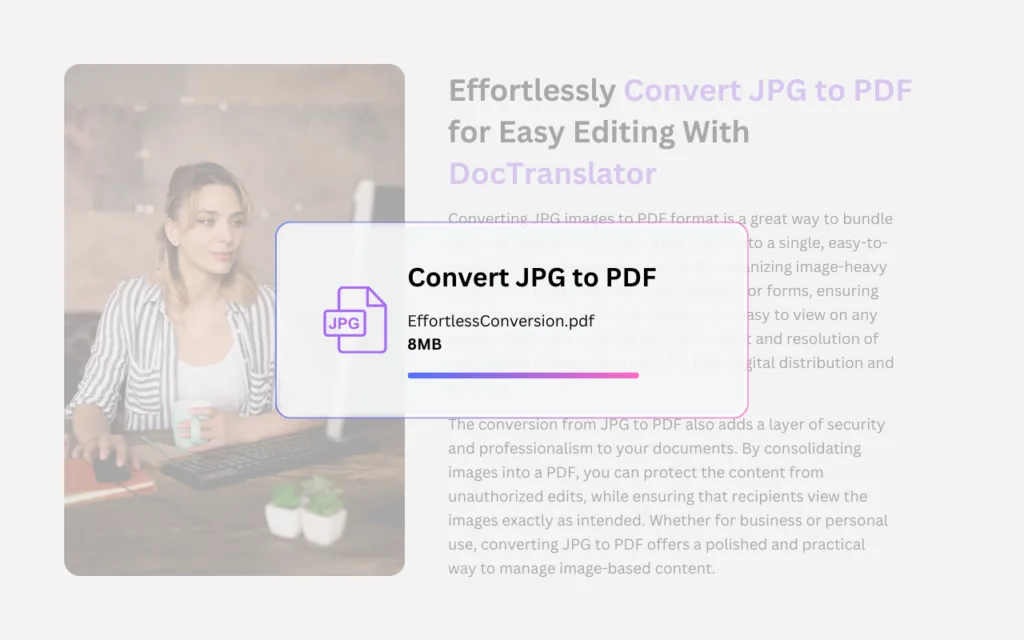
JPG na PDF en wat ons kan doen
DocTranslator.com is 'n outomatiese dokumentvertaler wat enige PDF, Word- of Excel-lêer na meer as 120 tale omskakel. Hierdie instrument, gebou met eenvoud in gedagte, bied die laagste pryse op aarde, begin by slegs $0.005/woord. Dit is 'n breukdeel van die koste van professionele menslike vertaling.
Gebruikers van DocTranslator.com kan enige bankstaat vinnig vertaal, hetsy dit MS Word, PDF, Excel of PowerPoint is, van Engels na Spaans en andersom. In totaal ondersteun DocTranslator meer as 120 tale, insluitend: Engels, Spaans, Frans, Duits, Portugees, Italiaans, Japannees, Kantonees, Mandaryns en Koreaans.
Moet jy 'n hele webwerf vertaal in plaas van 'n dokument? Ons vennoot ConveyThis.com hanteer volledige webwerfvertaling, wat 'n ander taak is as om 'n lêer te vertaal.
HOE DIT WERK
Stap 1: Skep 'n Gratis Rekening
Begin jou vertaalreis deur 'n gratis rekening op ons platform op te stel. Dit neem slegs 'n paar oomblikke om jou basiese inligting te verskaf en jou e-posadres te bevestig. Hierdie rekening sal dien as jou persoonlike spilpunt vir die oplaai, opspoor en bestuur van al jou vertaalprojekte.
Stap 2: Laai 'n Lêer Op
Nadat jy aangemeld het, is dit tyd om jou dokument op te laai. Ons stelsel ondersteun 'n wye verskeidenheid formate, insluitend MS Word, Excel, PowerPoint, TXT, InDesign, en CSV. Sleep en los eenvoudig jou lêer of gebruik die "Blaai"-opsie om die lêer vanaf jou toestel te kies.
Stap 3: Kies die Oorspronklike en Teiken Tale
Spesifiseer die taal waarin jou oorspronklike dokument geskryf is. Kies dan die teikentaal waarna jy die dokument wil laat vertaal. Met ons uitgebreide lys van ondersteunde tale, sal jy die perfekte pasmaat vir jou gehoor vind, hetsy dit vir 'n sakevoorstel of 'n kreatiewe veldtog is.
Stap 4: Klik die Vertaalknoppie en Laai Af
Sodra jy jou taalvoorkeure gestel het, klik die "Laai Op" knoppie om die verwerking te begin. Sit terug en ontspan terwyl ons gevorderde vertaalstelsel aan jou lêer werk, die oorspronklike uitleg en styl behou terwyl 'n akkurate vertaling gelewer word.
Gereelde Vrae
Hoe skakel ek 'n JPG na PDF om?
Laai jou JPG-beeld op met die omskakelaar hierbo en klik "Skakel om na PDF". Die JPG na PDF-omskakelaar deur DocTranslator verander jou beeld binne sekondes in 'n gepoleerde PDF, gereed om af te laai.
Kan ek veelvuldige JPG-beelde in een PDF kombineer?
Ja. Die hulpmiddel is veral nuttig vir die kombinasie van veelvuldige JPG-beelde, soos foto's, geskandeerde dokumente, of ontwerpe, in 'n enkele, georganiseerde PDF-dokument.
Verminder die omskakeling na PDF my beeldkwaliteit?
Nee. Die omskakelingsproses behou die oorspronklike beeldkwaliteit terwyl jou JPG's in 'n netjiese, maklik deelbare PDF gerangskik word.
Wat is die verskil tussen JPG en PDF?
JPG (JPEG) is 'n beeldformaat wat verlies aan kompressie gebruik om beeldkwaliteit en lêergrootte te balanseer. PDF (Portable Document Format) bewaar die formatering van 'n dokument sodat dit dieselfde lyk op enige toestel, sagteware of bedryfstelsel, wat dit ideaal maak vir die deel en aanbieding van jou beelde.
Hoekom JPG-beelde na 'n PDF omskakel?
'n PDF is ideaal wanneer jy beelde op 'n meer formele of veilige manier moet aanbied, soos vir kontrakte, aanbiedings, portefeuljes of dokumentasie. PDFs kan ook wagwoordbeskerm of geïnkripteer word vir bykomende sekuriteit en word hoogs saamgepers vir maklike deel via e-pos of aanlyn platforms.
Watter toestelle kan die PDF wat ek skep oopmaak?
Byna enige. Die meeste moderne toestelle kom met ingeboude PDF-kykers, en baie webblaaiers ondersteun PDF-lees sonder bykomende sagteware, so jou omgeskakelde lêer is maklik om oop te maak en te deel.
Vertaal jou lêer nou!
Registreer vandag en ontdek die krag van DocTranslator en hoeveel verskil dit vir jou en jou besigheid sal maak.
Ons Vennote


Meer PDF-gereedskap & Vertalingsdienste
PDF Gereedskap