
Translate PDF to Thai online
Translate PDFs between English and Thai. Thai script is written without spaces between words, so the translation engine handles word segmentation automatically and outputs correctly segmented Thai text with vowel marks positioned above, below, and beside consonants. Files up to 1 GB.
Upload or drop document to translate
Max. file size 1 GB
- OCR for scans and photos
- 108 languages
- Original layout kept
What happens when you translate a PDF to or from Thai
Thai script runs left to right, which is the same direction as English, but the two writing systems diverge almost immediately after that. Thai has 44 consonants organized into three classes (high, mid, and low) that interact with tone marks to determine the pronunciation of every syllable. Vowels are not always written after the consonant they modify: depending on the vowel, it may appear above, below, to the left, or to the right of the consonant it belongs to. This positioning is part of standard Thai orthography, and any output that places vowels incorrectly will look wrong to a Thai reader even if the words are otherwise correct.
One of the most distinctive features of Thai is that there are no spaces between words. A sentence is a continuous string of characters, and a reader identifies where one word ends and the next begins by recognizing vocabulary and applying grammatical knowledge. For a translation engine, this means word boundaries must be inferred during both the analysis of the source text and the generation of the Thai output. The engine used here applies linguistic knowledge of Thai vocabulary and grammar to segment the output correctly, placing line breaks at natural word boundaries so the text reads as fluently as native Thai prose.
Thai also has five tones (mid, low, falling, high, and rising), and the tone of a syllable depends on three interacting factors: the class of the initial consonant, the length of the vowel, and any tone mark written above the consonant. This is a very different system from English, which has no lexical tones at all. For a translated PDF, the correct tonal interpretation is embedded in the conventional spelling of each Thai word rather than being marked separately, so the output does not add extra notation beyond standard Thai orthography. Thai also has no grammatical gender, no plural inflection, and no verb conjugation for tense, which makes the grammar simpler than English in those respects even as the script is more complex.
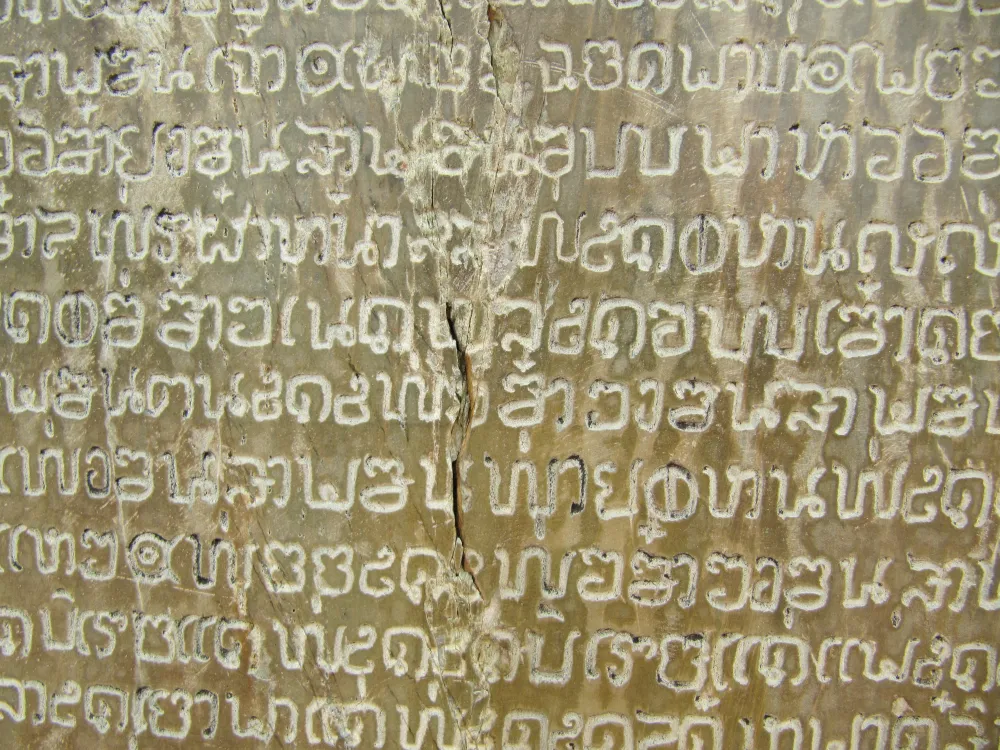
Thai script and the challenge of word segmentation
Thai is spoken by about 60 million people in Thailand, with regional dialects across the north, northeast, central, and south of the country. Standard Central Thai is the written and official form used in all documents. The Thai script is an abugida: consonants carry an inherent vowel sound that is modified by surrounding vowel symbols appearing above, below, or beside the consonant. The script runs left to right, but unlike European scripts, there are no spaces between words. Word boundaries must be inferred from context, which is a task that the underlying language model handles by recognizing common Thai vocabulary and grammar patterns.
Thai has five tones, and the tone of a syllable depends on three interacting factors: the class of the initial consonant (high, mid, or low), the length of the vowel, and any tone mark present. This system means that the same written sequence can represent different words in different tone contexts. For a translated PDF, the correct tonal interpretation is built into the translation rather than being marked separately: the output uses the standard Thai orthography where each word's tone is implicit in its conventional spelling.
Documents people translate between English and Thai
Thailand is a major destination for foreign investment, medical tourism, and expatriate residents, and the documents that cross the language boundary reflect that activity:
- Legal contracts and business agreements for companies operating in Thailand
- Immigration and visa documents for tourists, expats, and Thai nationals abroad
- Personal documents (birth certificates, ID cards, house registration) for Thais overseas
- Medical records for foreign patients treated in Thai hospitals and for Thais abroad
- Tourism and hospitality documents, hotel contracts, and travel agreements
- Technical manuals and product documentation for goods entering or leaving the Thai market
AI translation handles reading, internal review, and first drafts well. Documents submitted to Thai courts or government bodies, including personal status certificates filed for visa applications, generally require certified translation with a professional certifying that the output is accurate and complete.
English to Thai PDF translation pricing
Sign up free, pay per document, and upgrade as your translation needs grow.
Free
No card needed to sign up
- $0.005/word AI translation
- $1 per page for scans and image PDFs
- 108 languages
- Files up to 20 MB and 20 pages
- DOCX, PDF, XLSX, PPTX, IDML, TXT, JPG, PNG and CSV
- 24-hour file storage only
- PDF editor and PDF to DOCX converter
Basic
Most popularBilled every week · cancel any time
Billed monthly
Billed once a year · save 33%
- AI translation included every month
- Then $0.005/word AI translation
- Files up to 100 MB and 300 pages
- DOCX, PDF, XLSX, PPTX, IDML, TXT, JPG, PNG and CSV
- OCR for scanned documents
- Document storage
- Priority support
- 7-day free trial on the monthly plan
- Cancel any time
Pro
Billed monthly
Billed once a year · save 34%
- AI translation included every month
- Then $0.004/word AI translation
- Files up to 1 GB and 5,000 pages
- DOCX, PDF, XLSX, PPTX, IDML, TXT, JPG, PNG and CSV
- Glossary
- Priority queue
- 5 team seats
- API requests · 1,000 pages a month
- MCP access for AI assistants
- Cancel any time
Business
Billed monthly
Billed once a year · save 33%
- AI translation included every month
- Then $0.003/word AI translation
- Files up to 1 GB and 5,000 pages
- DOCX, PDF, XLSX, PPTX, IDML, TXT, JPG, PNG and CSV
- Glossary
- Priority queue
- 15 team seats
- API requests · 5,000 pages a month
- MCP access for AI assistants
- Cancel any time
Enterprise
Need more volume, invoicing or a custom agreement? Talk to us about an Enterprise plan.
How to translate your PDF to Thai
Create a free account
Sign up with your email to access the online translation dashboard.
Upload your PDF file
Drag and drop your file or browse to select it. Files up to 1 GB are supported on the Pro and Business plans.
Choose Thai as target language
Select the original language of your PDF and set Thai as the target language.
Translate and download
Click "Translate" and wait a few moments. Your translated PDF will be ready to download with Thai script and formatting preserved.
English to Thai PDF translation FAQ
How does DocTranslator handle Thai script with no spaces between words?
Thai word segmentation is handled by the translation model, which identifies word boundaries using linguistic knowledge of Thai vocabulary and grammar. The output follows the same convention: Thai text is written without spaces between words, with line breaks inserted at appropriate word boundaries.
Will Thai vowel symbols (above, below, and beside consonants) render correctly?
Yes. Thai vowels appear in multiple positions relative to consonants. The output uses a Thai-compatible font that positions all vowel marks correctly, so the script renders as it would in a native Thai document.
Can I translate from Thai into English?
Yes. The pair works in both directions.
What documents do businesses most often translate between English and Thai?
Legal contracts and joint-venture agreements for Thai operations; immigration and work permit documents; hotel and tourism contracts; medical records for foreign patients; and technical documentation for goods entering or leaving the Thai market.
Is AI translation enough for Thai legal documents submitted to Thai courts?
For reading and internal use, yes. Documents submitted to Thai courts or official bodies typically require certified, court-approved translation. See certified translation for official submissions.
How large a Thai PDF can I upload?
Up to 1 GB or 5,000 pages on Pro and Business, 100 MB and 300 pages on Basic, and 20 MB and 20 pages on Free.
Does DocTranslator handle Thai tone marks correctly?
Yes. Thai tones are encoded in conventional spelling using consonant classes and tone marks. The translation engine produces correctly spelled Thai words where the tonal information is embedded in the standard orthography.
Translate your PDF to Thai today
DocTranslator converts PDFs between English and Thai online, handling Thai word segmentation and vowel positioning automatically, with support for files up to 1 GB.
Related tools
Translate PDF by Language
Document Types
Our Partners