
Translate PDF to Indonesian
Translate any PDF into Bahasa Indonesia online. Agglutinative morphology expands word length and can reflow text across pages, and the translator handles formal Bahasa baku register required for official documents. Files up to 1 GB.
Upload or drop document to translate
Max. file size 1 GB
- OCR for scans and photos
- 108 languages
- Original layout kept
What happens when you translate a PDF into Indonesian
Bahasa Indonesia uses the Latin script, so the reading direction of your PDF stays left to right and the overall page orientation does not change. What does change is text length. Indonesian is an agglutinative language, which means a single base word can grow considerably through affixes. The prefix me- and suffix -kan together form a causative verb: "buku" (book) becomes "membukukan" (to record officially in a book). The prefix per- combined with suffix -an forms abstract nouns, and ke- with -an forms state nouns. A short English phrase can expand into a longer Indonesian equivalent once the correct affixes are applied, and that expansion causes text to reflow inside the PDF. Columns that fit neatly in the English original may overflow or wrap differently in the Indonesian output.
Register matters significantly for document translation into Bahasa Indonesia. The language has two clearly distinct registers: formal Bahasa baku, used in government documents, legislation, academic papers, and official contracts; and colloquial Bahasa gaul, used in everyday conversation and informal writing. Official Indonesian documents must use Bahasa baku. The spelling conventions for this formal register were standardised by the 1972 EYD reform, which also unified Indonesian spelling with Malaysian Malay. That reform changed several digraphs: "tj" became "c", "dj" became "j", and "nj" became "ny". A translation that uses pre-1972 spelling conventions in a modern document will look outdated to any Indonesian reader.
Indonesian also lacks grammatical tenses, grammatical gender, and obligatory plural marking. English sentences rely heavily on auxiliary verbs and plural forms to convey time and quantity, and translating those into Indonesian requires the translator to infer meaning from context rather than applying direct grammatical equivalents. Plural is often indicated by reduplication ("buku-buku" for books), but formal documents frequently omit even this marker when context is clear. The result is that an Indonesian PDF may appear more concise in some passages and more expanded in others compared to the English source, depending on how much the affixation system is applied.
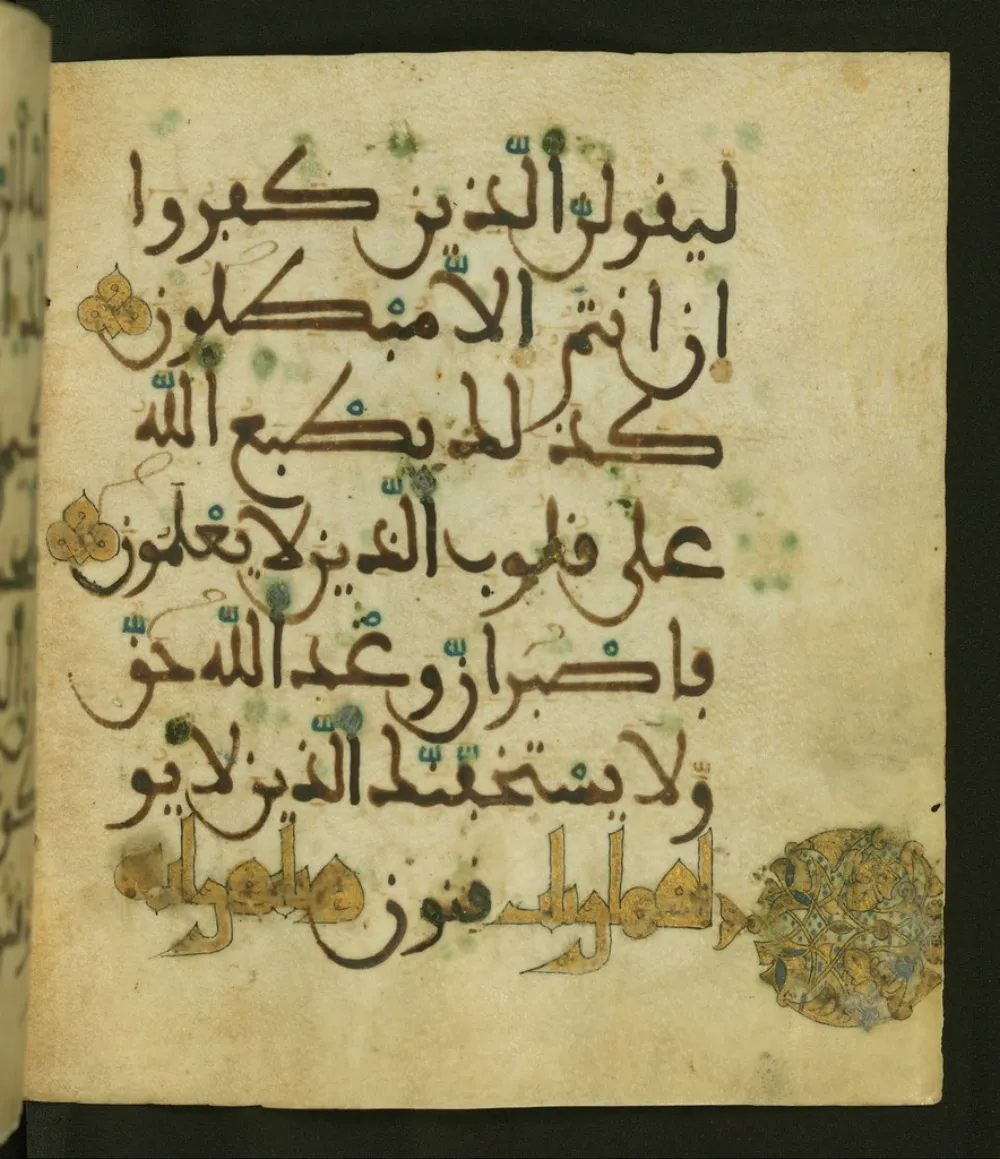
Bahasa Indonesia's Latin script replaced a centuries-old Arabic writing tradition
Before Indonesia's 1945 independence, the dominant writing system for Malay-based texts across the archipelago was Jawi, an Arabic-derived script adapted for Malay sounds. Jawi was the language of Islamic education, religious manuscripts, royal correspondence, and trade documents for centuries across the region. It remains in use today in Indonesian religious education and in parts of Malaysia. Modern official Indonesian documents use the Latin alphabet introduced with independence, but older archival documents, certificates from religious institutions, and some community records may still be written in Jawi, requiring a translator familiar with both scripts.
With 270 million total speakers, of whom around 45 million speak it as their first language and the rest as a learned national language, Bahasa Indonesia ranks among the ten most spoken languages in the world. It is the working language of the fourth most populous country on earth and the official language of ASEAN proceedings alongside English. Its vocabulary draws heavily from Dutch (polisi for police, gratis for free, wortel for carrot), Arabic (waktu for time, selamat for greeting, kitab for holy book), and English (komputer, internet, film). A translator working into formal Bahasa Indonesia must navigate which loanword register is appropriate for each context, since Dutch loanwords are sometimes considered informal while their Sanskrit or indigenous equivalents carry a more official tone.
Documents people translate between English and Indonesian
Indonesia's 280-million-person economy, its large diaspora communities in Australia, the Netherlands, and New Zealand, and its role as an ASEAN member generate a wide range of documents that cross between Bahasa Indonesia and English every day:
- Immigration documents for Indonesian nationals applying to Australia and New Zealand, where Indonesian is a common foreign-language document language processed by immigration authorities
- Academic transcripts and degree certificates from Indonesian universities for postgraduate study applications abroad
- ASEAN business contracts and joint-venture agreements between Indonesian and English-speaking counterparties
- Government-issued identity documents, including Indonesian KTP (national ID cards) and family cards (Kartu Keluarga), for diaspora legal purposes in the Netherlands and elsewhere
- Legal documents in Indonesian civil and commercial law for international arbitration or due diligence in Indonesian acquisitions
- Medical reports and health certificates from Indonesian hospitals for international insurance claims or visa medical requirements
AI translation works well for reading a document, sharing it internally, or preparing a working draft. Official submissions to government immigration offices typically require a certified translation reviewed and signed by a qualified human translator.
English to Indonesian PDF translation pricing
Sign up free, pay per document, and upgrade as your translation needs grow.
Free
No card needed to sign up
- $0.005/word AI translation
- $1 per page for scans and image PDFs
- 108 languages
- Files up to 20 MB and 20 pages
- DOCX, PDF, XLSX, PPTX, IDML, TXT, JPG, PNG and CSV
- 24-hour file storage only
- PDF editor and PDF to DOCX converter
Basic
Most popularBilled every week · cancel any time
Billed monthly
Billed once a year · save 33%
- AI translation included every month
- Then $0.005/word AI translation
- Files up to 100 MB and 300 pages
- DOCX, PDF, XLSX, PPTX, IDML, TXT, JPG, PNG and CSV
- OCR for scanned documents
- Document storage
- Priority support
- 7-day free trial on the monthly plan
- Cancel any time
Pro
Billed monthly
Billed once a year · save 34%
- AI translation included every month
- Then $0.004/word AI translation
- Files up to 1 GB and 5,000 pages
- DOCX, PDF, XLSX, PPTX, IDML, TXT, JPG, PNG and CSV
- Glossary
- Priority queue
- 5 team seats
- API requests · 1,000 pages a month
- MCP access for AI assistants
- Cancel any time
Business
Billed monthly
Billed once a year · save 33%
- AI translation included every month
- Then $0.003/word AI translation
- Files up to 1 GB and 5,000 pages
- DOCX, PDF, XLSX, PPTX, IDML, TXT, JPG, PNG and CSV
- Glossary
- Priority queue
- 15 team seats
- API requests · 5,000 pages a month
- MCP access for AI assistants
- Cancel any time
Enterprise
Need more volume, invoicing or a custom agreement? Talk to us about an Enterprise plan.
How to translate your PDF to Indonesian
Create a free account
Sign up with your email to access the online translation dashboard.
Upload your PDF file
Drag and drop your file or browse to select it. Files up to 1 GB are supported on the Pro and Business plans.
Choose Indonesian as target language
Select the original language of your PDF and set Indonesian (Bahasa Indonesia) as the target language.
Translate and download
Click "Translate" and wait a few moments. Your translated PDF will be ready to download in Bahasa Indonesia with formal register applied.
English to Indonesian PDF translation FAQ
Does Indonesian use any special characters that can cause PDF rendering problems?
Bahasa Indonesia uses standard Latin characters with no diacritics beyond the occasional "e" with a schwa sound, which is not marked in writing. The Latin script means there are no right-to-left reflow issues, no ligature complexities, and no font substitution problems of the kind that occur with Arabic or CJK scripts. The main rendering challenge is text expansion caused by agglutinative affixes, which can push text into adjacent columns or overflow text boxes in tightly laid-out PDFs.
How does Indonesian agglutinative grammar affect the length of my translated PDF?
Indonesian builds words by stacking affixes onto a root: me-, ber-, per-, -kan, -an, -i, and ke--an are among the most common. A single English noun or verb can become a significantly longer Indonesian word once the appropriate prefix and suffix are attached. In practice this means paragraphs in a bahasa indonesia pdf translation are often 10-20% longer than the English source, which can cause page count to increase or text to reflow within fixed-size text frames.
Which Indonesian register is used: formal Bahasa baku or colloquial Bahasa gaul?
DocTranslator targets formal Bahasa baku for all document translation. Official Indonesian documents, contracts, academic transcripts, and government forms all require this register. Bahasa gaul, the colloquial spoken register used in everyday conversation, is not appropriate for any official or professional document. The 1972 EYD spelling reform conventions are applied throughout, so the output uses modern standard spellings rather than pre-independence Dutch-era orthography.
Can I translate Indonesian immigration documents for Australian or New Zealand visa applications?
Yes. Australia and New Zealand are among the most common destinations for Indonesian nationals and process a large volume of Indonesian-language documents. AI translation is useful for preparing a draft or understanding the content of a document. However, visa and immigration submissions to the Australian Department of Home Affairs or Immigration New Zealand typically require a certified translation by a credentialed translator, such as a NAATI-certified professional in Australia.
Can I translate from Indonesian to English as well as English to Indonesian?
Yes. The pair works in both directions. Translating an Indonesian PDF into English is equally supported, whether the source is a formal government document in Bahasa baku, an academic transcript from an Indonesian university, or a legal contract from an Indonesian business. The same file size limit of 1 GB applies in both directions.
How does the translator handle Indonesian loanwords from Dutch, Arabic, and English?
Bahasa Indonesia contains a large loanword inventory drawn from Dutch (polisi, gratis, wortel), Arabic (waktu, selamat, kitab), and English (komputer, internet, film). These words are treated as standard Indonesian vocabulary and are preserved or reproduced correctly in the translated output. When translating from English into Indonesian, technical and scientific terms that have been adopted directly into Indonesian (such as "internet" or "film") are kept in their Indonesian form rather than being back-translated into older synonyms.
Does Indonesian reduplication like "buku-buku" translate correctly?
Indonesian uses reduplication (repeating a root word) to indicate plurality or emphasis: "buku-buku" means books, "anak-anak" means children, "berlari-lari" means to keep running. The AI correctly generates reduplication in the Indonesian output where the English source implies plurality or repeated action. In formal Bahasa baku documents, reduplication is used selectively; context often makes quantity clear without it, and the translator applies the register-appropriate choice.
Translate your PDF to Indonesian today
DocTranslator converts PDFs between English and Bahasa Indonesia online, applying formal Bahasa baku register and handling the text expansion that comes from Indonesian agglutinative morphology, with file support up to 1 GB.
Related Tools
Translate PDF by Language
Document Types
Our Partners